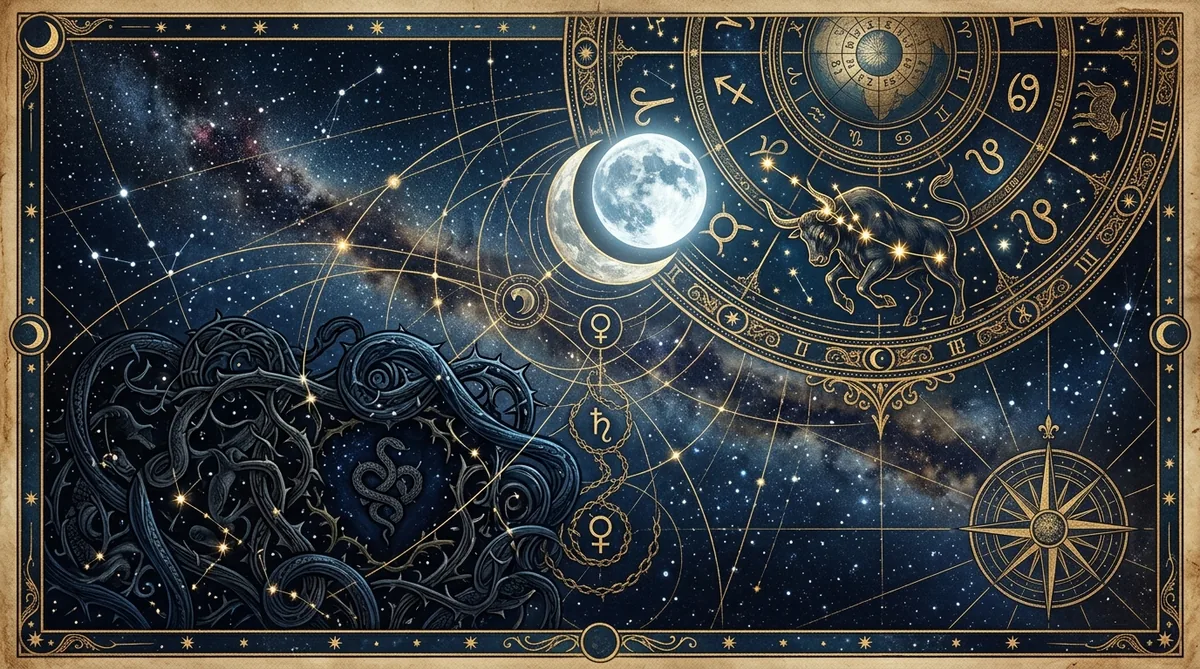

There are relationships that trouble us loudly, and there are relationships that trouble us in silence. The Moon in Taurus belongs to the second kind. Outwardly, nothing appears broken. The tone is civil, the gestures familiar, the routines intact. Yet beneath the steadiness, something in the soul stiffens. You may find yourself smiling through conversations while a private alarm keeps sounding in the background of your mind.
This is the atmosphere of hidden threat — not always visible, not always provable, but deeply felt. Taurus seeks safety, loyalty, and tangible peace. When the Moon moves through this sign, emotional instinct becomes protective, earthy, and slow to trust disruption. If unease persists in a close bond during this time, it often signals that the heart has noticed what the intellect is still trying to explain away. The question is not whether fear is present. The deeper question is what truth fear is guarding.
The Psychological Layer
Psychologically, this experience often begins as a split between appearance and intuition. One part of the mind wants to preserve the image of stability, because stability feels like survival. Another part has already registered inconsistency — a tone that does not match the words, affection that arrives with calculation, reassurance that somehow increases suspicion rather than calming it. The psyche then produces symbols of threat: a snake, a shadow, a tightening coil of thought. These are not random fragments. They are images of instinct alerting consciousness.
Taurus is associated with security, embodiment, and possession, so emotional disturbance here tends to center on trust, loyalty, and the fear of losing ground. If betrayal or dishonesty is involved, even in subtle form, the injury is not merely relational. It becomes existential. You begin to question your reading of reality itself. Was the warmth genuine. Was the kindness strategic. Was the silence innocent or concealing something. This is why the unease can become obsessive. The mind circles because it is trying to restore a dependable world.
Yet not every fear is proof, and not every intuition is fantasy. The real psychological burden lies in ambiguity. You may be carrying evidence too small to justify confrontation but too sharp to ignore. In such moments, what torments the soul is often not the wound alone but the suspended state around it. Unnamed doubt feeds on vagueness. Once a fear is named plainly, it stops moving like poison through the system and becomes something the conscious mind can finally examine.
The Biblical Layer
Biblically, hidden threat often appears in the language of serpents, double speech, and the breach of trust beneath pleasing surfaces. The serpent in Genesis does not begin with violence but with suggestion, distortion, and a subtle rearranging of what is true — Genesis 3:1-5. This is why spiritual unease should not be dismissed simply because outward conflict has not yet erupted. Scripture repeatedly shows that corruption first works in secrecy, in whispers, in the inward chamber where discernment is either sharpened or sedated.
The Psalms speak with startling honesty about relational deceit. "His speech was smooth as butter, yet war was in his heart" — Psalm 55:21. That verse captures the emotional dissonance many people feel under a Moon in Taurus atmosphere: the surface remains soft while the inner field feels armed. Proverbs also warns that the heart can perceive danger before the social mask falls away — "A prudent man foreseeth the evil, and hideth himself" — Proverbs 22:3. Biblical wisdom does not teach paranoia, but it does honor discernment as a form of moral sobriety.
There is also a deeper theological tension here. Human beings often cling to false peace because truth threatens the structures that make life feel manageable. Jeremiah rebukes those who cry, "Peace, peace; when there is no peace" — Jeremiah 6:14. In spiritual terms, unease can become a mercy. It interrupts denial. It refuses cosmetic harmony. It presses the soul toward what Christ calls truth that makes one free — John 8:32. Freedom in Scripture is rarely comfortable at first. It usually begins with exposure.
The Cosmic Layer
The Moon returns to Taurus roughly once every 27.3 days in its sidereal cycle, and its passage through any one sign is brief, lasting about two to three days. That makes this kind of emotional weather acute rather than permanent. What feels overwhelming in the moment may belong to a short window in which buried material rises quickly and insists on recognition. The intensity can be disproportionate to the visible event because the trigger is current while the emotional content may be much older.
In lived experience, this symbolism tends to recur during seasons when security is under review. It appears when relationships are becoming more defined, when shared resources are being discussed, when domestic routines harden into commitments, or when a person has recently emerged from one betrayal and unconsciously scans for another. It is especially common during the night hours and early morning waking states, when social defenses are weaker and unresolved impressions rise without the usual daytime censorship.
There are also repeating life stages in which this pattern becomes more pronounced. It often surfaces in the late twenties and early thirties, when choices about partnership and permanence grow heavier, and again in midlife, when long-standing arrangements are tested against inner truth. In each recurrence, the theme is similar: what once felt safe is being re-evaluated. The emotional body does not ask first whether change is convenient. It asks whether the ground beneath attachment is real.
I watch these signs as a man watches the horizon before dawn, when shapes are still half-hidden and the light has not yet declared what they are. When the Moon moves through Taurus and your spirit grows restless in the presence of someone who should feel safe, I do not dismiss that trembling. I have learned that the soul often knows before the mouth can speak. I have seen how a hidden fracture first appears as heaviness, repetition, and a question that will not leave.
I tell you this plainly: I do not believe every fear, but I do respect every pattern that returns with force. If a thought wakes you night after night, if your peace collapses after each encounter, if politeness in the other person deepens rather than eases your suspicion, then I would regard that as a signal worth honoring. I would not call you foolish for sensing what has not yet fully shown itself. I would say that truth is approaching, and your inner life is already making room for it.
Practical Guidance
Tomorrow morning, before looking at your phone or speaking to anyone, take a page and write every doubt you have about this relationship in direct language. Do not polish it. Do not spiritualize it. Name the fear exactly as it appears: what feels false, what feels withheld, what memory keeps returning, what bodily sensation emerges when you think of the person. The purpose is not drama but definition. What is written can be examined. What stays vague often rules from the shadows.
Then read what you wrote and separate fact from interpretation in full sentences. Record what was said, what was done, what changed, what was promised, what was avoided. After that, write the meaning you have attached to those events. This simple distinction can reveal whether your anguish comes from concrete inconsistency, old wounds being activated, or a painful mixture of both. Clarity begins when the soul stops forcing instinct and evidence into the same blurred container.
Finally, create one contained ritual of truth for the next seven days. Return to the same page each morning and add only what repeats. Notice whether the same fear appears, whether new details emerge, or whether the charge begins to fade. Repetition is diagnostic. If the concern persists with coherence, it deserves serious attention. If it dissolves once named, then the act of conscious witnessing may already be loosening its grip. In either case, writing becomes a boundary against mental spiraling and a witness to what your deeper self is trying to show you.
Frequently Asked Questions
What does Moon in Taurus mean for relationships?
Moon in Taurus in relationships often points to a strong desire for loyalty, predictability, and emotional safety. When discomfort appears during this transit, it can feel especially threatening because it disturbs the very ground of trust. People may become more sensitive to inconsistency, mixed signals, or hidden motives. The transit does not automatically predict betrayal, but it can heighten awareness of tensions that were already present beneath the surface.
Why do I feel uneasy even when nothing looks wrong?
Unease without visible proof usually arises when intuition detects a mismatch between appearance and reality. This can happen through subtle changes in tone, rhythm, avoidance, or emotional presence that the conscious mind has not yet fully organized. The body often notices before the intellect does. That does not mean every suspicion is correct, but it does mean inner discomfort deserves honest attention, especially when the same fear repeats and refuses to disappear.
Explore Dream Symbols Connected to These Transits
Symbols and emotions from this reading often echo the archetypes catalogued in the dream symbol dictionary, where you can explore related entries and go deeper into what your subconscious is revealing.
✦ This content is for spiritual and entertainment purposes only. Dream and astrological interpretation is a symbolic language, not a predictive science. Always consult qualified professionals for decisions affecting your health, finances, or legal matters.