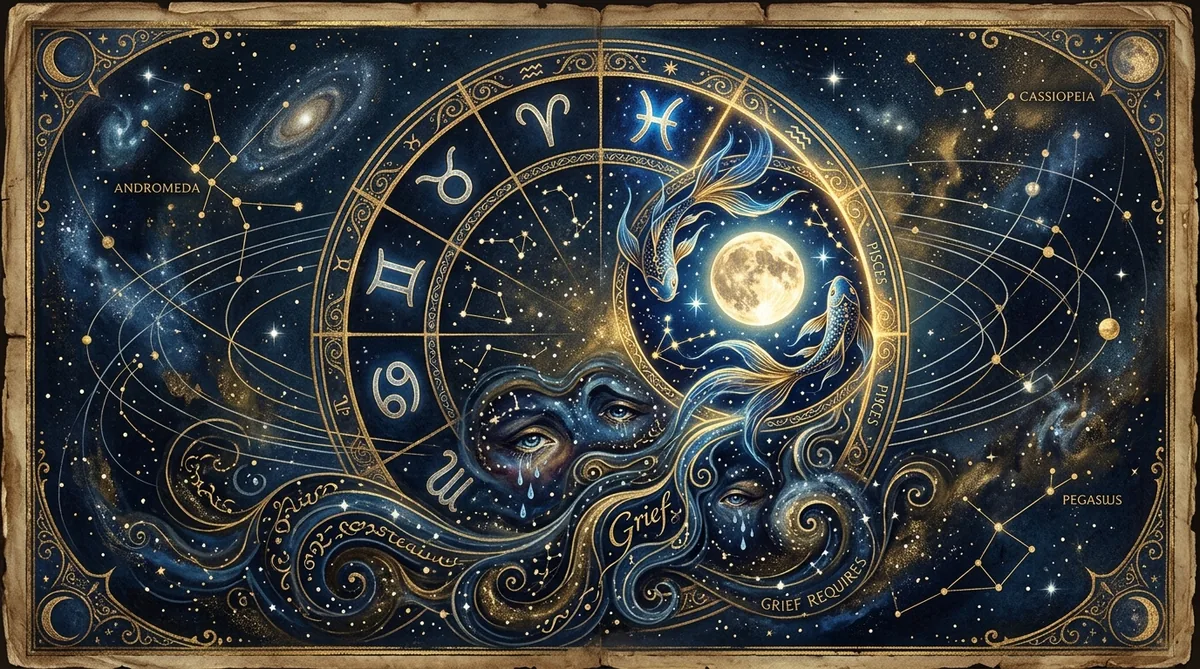

There are seasons when grief does not arrive as a clean event but as a tide. It gathers in the body, behind the eyes, in the throat that tightens at odd hours, in the sudden memory of a person, a path, a life that did not continue. Under the Full Moon in Pisces, what has been drifting beneath awareness often rises all at once, and the soul feels what the mind has tried to postpone.
This is why certain endings return with unusual force now. A relationship that dissolved without true language, an opportunity that slipped away, a dream that never took form—these do not vanish because they were ignored. They wait. And when emotion ripens, they come back asking not to torment you, but to be witnessed. The letter you have not written may be the threshold between lingering sorrow and honest release.
The Psychological Layer
Psychologically, avoided grief rarely disappears; it changes form. What is not spoken often becomes mood, fatigue, irritability, numbness, or a vague sense of being unable to move forward. The psyche is economical in this way—it will store unfinished feeling until the ego is ready, or forced, to turn and face it. When loss remains unprocessed, the inner life begins to circle around absence as though around a hidden well.
Pisces symbolism intensifies this pattern because it speaks to porous boundaries, memory, longing, dream residue, and emotional fusion. In depth psychology, water images often correspond to material emerging from the unconscious. The feeling may seem sudden, but in truth it has been accumulating. A recent trigger—a song, a date, a message, a silence—can break the seal and allow older sorrow to flood the present moment. Then the grief is no longer only about what ended yesterday, but about every earlier ending that resembled it.
The unsent letter matters because it gives shape to what has remained formless. Language creates a vessel. Instead of letting grief diffuse through the nervous system, writing localizes it, names it, and permits relationship with it. One may discover beneath sadness a more difficult confession—anger, shame, relief, regret, even love that has nowhere to go. What is feared in such a letter is often not weakness, but truth. Yet truth on the page becomes the beginning of psychic order.
The Biblical Layer
Scripture treats lament not as failure of faith but as one of its deepest languages. The psalmists do not hide their unrest before God; they articulate it with startling candor. “My tears have been my food day and night” appears in Psalm 42:3, and in Psalm 6:6 the soul speaks plainly: “I am weary with my groaning; all the night make I my bed to swim.” Biblical spirituality does not demand emotional suppression. It asks for truthful utterance in the presence of the Holy.
The biblical witness also understands that grief clings when it is not ritually expressed. David mourns, weeps, fasts, and speaks his anguish aloud in 2 Samuel 1:11-12. Ecclesiastes 3:1-4 insists there is “a time to weep” and “a time to mourn,” suggesting that sorrow has its appointed season and becomes disordered when denied. Even Jesus at the tomb of Lazarus does not bypass grief with doctrine; “Jesus wept” in John 11:35. The tears themselves become revelation.
There is, too, a prophetic dimension to writing what cannot be said face to face. Habakkuk 2:2 begins, “Write the vision, and make it plain,” and though the context is not personal loss, the principle endures—what is written becomes legible to the soul. The letter to the absent beloved, the broken future, the closed door, may function almost as lament literature in miniature. In placing sorrow into words, one ceases to worship the ghost of what was and begins instead to tell the truth before God, who “healeth the broken in heart, and bindeth up their wounds” in Psalm 147:3.
The Cosmic Layer
A Full Moon is a measurable astronomical event: it occurs when the Moon stands opposite the Sun in the sky, completing the bright culmination of the synodic cycle of roughly 29.5 days. Human beings have long attached emotional meaning to this visible fullness because it coincides with culmination, exposure, and heightened night illumination. Whether or not one grants symbolic power to the moment, it remains a recurring temporal marker—something unfinished often feels more noticeable when a cycle appears complete.
Pisces season and Pisces lunations tend to be associated, in symbolic calendars, with endings, permeability, surrender, and the dissolving of rigid psychic defenses. Yet the experience described here often has a very concrete waking-life rhythm. It commonly appears after anniversaries of loss, during transitions between jobs or relationships, near birthdays, at the close of summer, in the weeks after a major decision, or when outer busyness finally quiets enough for inner backlog to speak. Grief often surfaces not at the moment of impact but when survival mode loosens its grip.
There are also life-stage recurrences that give this sorrow a pattern. Many revisit unresolved endings in the late twenties, around midlife, after children leave home, after divorce, after relocation, or in the aftermath of caring for aging parents. The psyche works cyclically even without mystical framing. What was once too overwhelming to feel may return years later in a more symbolized form—a dream, a memory, a compulsion to write, a sudden ache at dawn. The timing is rarely random; it usually reflects a threshold where the self is finally able to bear what it once had to postpone.
I tell you this plainly—I have seen how the heart buries what the mouth cannot confess. You call it moving on, but beneath the silence the old wound keeps speaking. When grief comes like water, it is not always sent to drown you. Sometimes it comes to wash the hidden chambers clean. If you are troubled by what rises now, do not mistake its return for punishment. The buried thing returns because it seeks a name.
If you write the letter, write it without performance. I would not have you compose a polished testimony while the soul remains guarded. Say what you did not say. Say what broke in you. Say what you lost, what you wanted, what you still cannot forgive. I have learned that when truth is brought from secrecy into form, heaven often begins its work there—not by erasing the past, but by loosening its dominion over the future.
Practical Guidance
Tomorrow morning, before checking your phone or speaking to anyone, sit with paper and write a letter addressed to the person, ending, or missed possibility that still lives inside you. Use direct language. Name what happened, what was never resolved, what you needed, what you resent, what you bless, and what you release. Do not edit for beauty. The value lies in honesty, not style.
After writing, read the letter aloud in a private space. Hearing your own words matters because grief often remains trapped as internal pressure until it is voiced. Notice where the body responds—the chest tightening, the breath catching, the jaw hardening, the sudden tears. Then date the letter and place it in an envelope, a journal, or a box reserved for sacred documents. The act of containment signals that the feeling has been witnessed rather than abandoned.
Before the day ends, create one visible gesture of closure tied to the letter. You might light a candle and sit in silence for seven minutes, walk to a specific place and pray Psalm 34:18, or tear a second page on which you have written the sentence you are ready to release. If the grief is deep, repeat this practice for three mornings, allowing different layers to emerge. Healing often begins not with one dramatic breakthrough, but with a series of truthful encounters.
Frequently Asked Questions
Why does the Full Moon in Pisces make grief feel stronger?
The Full Moon in Pisces is often interpreted as a time when emotional material becomes harder to suppress. Pisces symbolizes memory, longing, endings, and porous inner boundaries, so unresolved loss may feel unusually close. Psychologically, this can coincide with moments when stress lowers or transitions open space for older feelings to return. The moon does not create grief from nothing—it often illuminates what was already waiting beneath conscious control.
What am I afraid to say in the letter I need to write?
Most people are not afraid of the paper itself—they are afraid of the truth that may appear on it. The letter may reveal anger alongside love, relief alongside sadness, or longing that has not ended. It may expose how deeply a missed opportunity shaped identity. Often the hardest sentence is the most simple: what I needed, what I lost, what I never said, and what still hurts now.
Explore Related Dream Symbols
Symbols and emotions from this reading often echo the archetypes catalogued in the dream symbol dictionary, where you can explore related entries and go deeper into what your subconscious is revealing.
This content is for spiritual and entertainment purposes only. Dream and astrological interpretation is a symbolic language, not a predictive science. Always consult qualified professionals for decisions affecting your health, finances, or legal matters.
About the author: AskYosef
The AskYosef editorial team (Dreams Desk). We turn the questions people ask about dreams, the sky and numbers into clear answers, in the tradition of Joseph.
How this article was made
This piece is written with AI assistance and published by the AskYosef editorial team. It is a symbolic reflection in the tradition of Joseph, not a prediction and not professional advice.